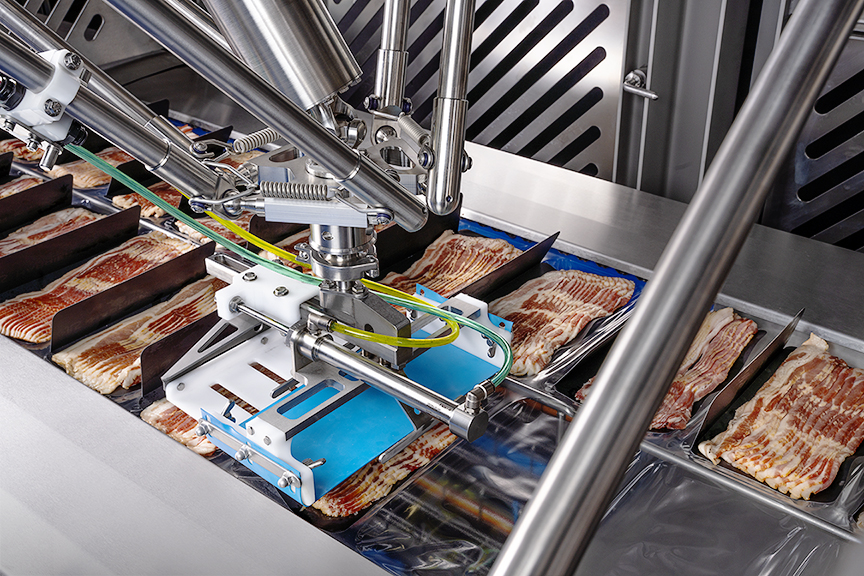
Bacon breaks ordinary automation.
So we built something different.
JLS builds robotic packaging automation purpose-built for bacon — an air-cylinder-actuated servo finger beneath the Harrier's pick conveyor lifts the sliced bacon draft's L-board flap, and mechanical, cylinder-actuated tooling seats the draft into the thermoformer pocket, an application JLS engineered specifically for bacon. Osprey® case-packs thermoformed packs, stand-up pouches, and bacon bits at line speed, with PIVT leak detection guarding every seal. IP69K-capable construction is designed to fit USDA-inspected bacon plants. Every line is engineered, programmed, and supported entirely in-house by JLS.
In action
Watch JLS handle bacon — at full production speed
Bacon Draft
Automatic bacon draft loading
The Harrier loads fresh sliced bacon drafts into thermoformers at full production speed.
Bacon’s toughest packaging headaches. Solved.
We’ve spent decades on protein lines. These are the problems bacon processors bring us most — and how JLS robotics solve them.

Sanitation & food safety under constant washdown

Floppy sliced bacon drafts that defy automation

Labor that’s hard to staff in cold, wet cut rooms
Throughput & consistency capped by hand-packing
Bacon packaging automation, draft loading to case packing.
From draft loading through case packing, JLS automates every step of a bacon line — all built for the daily washdown.
Bacon draft loading
Thermoformed pack case packing
Stand-up pouches & foodservice bags
Bacon bits & retail packs
Have a custom bacon product?
If it can be sliced, drafted, pouched, or bagged, our engineers have probably packed it — and if not, we’ll figure it out.
Test before you commit
Send us your bacon.
We'll put it to the test.
Before any capital commitment, send us your product — sliced bacon drafts, bellies, pouches, or bits. We’ll run it on real JLS robotics in our York, PA Flight Lab with tooling configured for it, and prove out the line on your actual product.
Designed to get wet. Built to be cleaned.
In a USDA-inspected bacon plant, sanitation isn't a feature — it's the whole game. Every JLS bacon system is engineered for the daily, high-pressure, high-temperature washdown so your line stays compliant and your downtime stays low.
* Specific JLS components are IP69K full-washdown rated; system-level ingress protection varies by configuration. Contact JLS for your application.
More automation insights
Engineering guides, application deep-dives, and ROI analysis for food manufacturers evaluating food packaging automation.
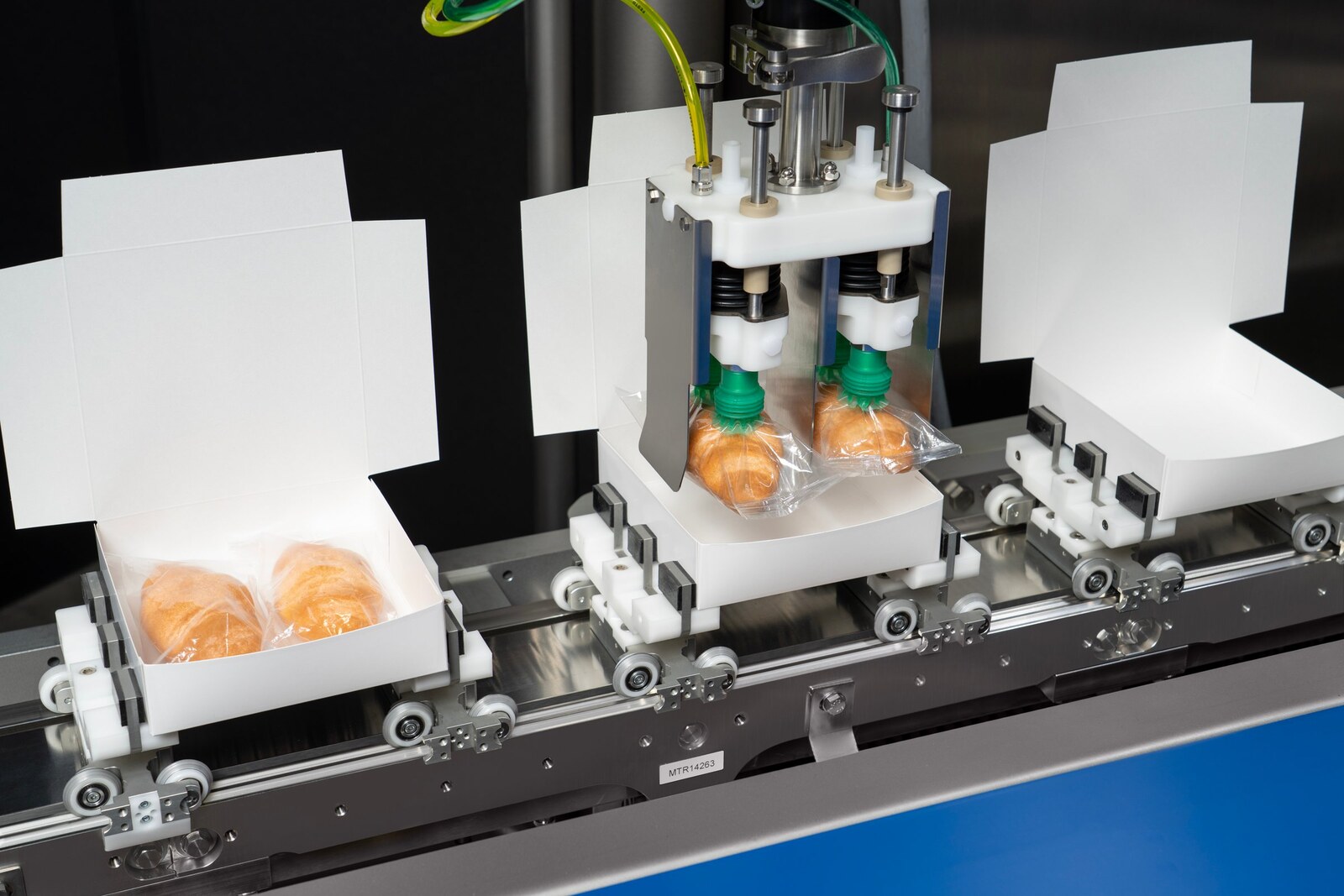
JLS Automation to run robotic food handling systems live at PACK EXPO International 2026
Booth S-2776 will feature carton-to-case integration, brick-pack case loading, AI vision and high-speed snack-stick collation, wit…

NAM Executive Committee Appoints JLS Automation President & CEO Craig Souser
YORK, Pa., Mar. 11, 2026 – JLS® is proud to announce that Craig Souser, President & CEO, has been appointed to the Executive C…

JLS® Appoints Sean Spees as Director of Cartoning Solutions
YORK, Pa., Jan. 6, 2026 – JLS Automation is pleased to welcome Sean Spees as Director of Cartoning Solutions. In this role, Spees …
Bacon packaging automation FAQs
Payback is commonly evaluated in the 24–36 month range, depending on labor cost, shift schedule, production volume, uptime improvement, and the specific bacon application. For bacon processors, the business case is often driven by labor savings, reduced manual handling, improved draft presentation, more consistent loading, less rework, better ergonomics, and more predictable packaging performance. Labor savings scale with line speed, labor model, and platform, with additional value from improved throughput and reduced product handling. JLS reviews the draft pattern, package format, line speed, staffing model, sanitation requirements, and current production challenges to help determine where automation can create the strongest return.
Sliced bacon drafts, thermoformed bacon-strip packs, retail stand-up pouches, bulk foodservice bags, pork bellies, and bacon bits — loaded into thermoformers and case-packed flat or vertical.
An air-cylinder-actuated servo finger beneath the Harrier’s pick conveyor lifts the L-board flap, and mechanical, cylinder-actuated tooling then seats the fresh sliced draft into the thermoformer pocket — engineered and lab-tested per product.
Yes. JLS bacon systems are wash-down capable and designed to fit USDA-inspected plants and the daily high-pressure, high-temperature washdown — with NEMA 4X controls, open-frame sloped stainless construction, and IP69K-capable components matched to the application.
Yes. JLS integrates with your bacon slicer, thermoformer, and tray sealer, plus your existing upstream and downstream equipment, into one coordinated bacon line.
Yes. JLS PIVT automatic leak detection inspects thermoformed and vacuum bacon packs in-line and rejects leakers before they reach the case — protecting shelf life and reducing returns.
Throughput depends on product and format. The Harrier loads bacon drafts at line speed, and Osprey case rates are sized to your line and SKU mix.
SKUs change via an HMI recipe, and end-of-arm tooling swaps by hand in minutes — no programming or maintenance call. Recipes are pre-loaded during commissioning so every product you run is mapped before the system ships.
Yes — when the system is designed specifically for bacon handling. Bacon drafts are flexible, slippery, inconsistent, and presentation-sensitive, so the automation has to control the product without disturbing the draft pattern or hurting pack appearance. A properly engineered robotic loading system like the JLS Harrier helps maintain draft presentation, reduce manual handling, and improve consistency from pick to placement.
Bacon drafts are not rigid products. They can slip, separate, distort, or vary in shape depending on temperature, slice quality, fat content, draft pattern, and upstream handling — which makes controlled product presentation and pick accuracy critical. Successful bacon draft automation takes more than a robot: it requires the right product handling, a vision or sensing strategy when needed, custom end-of-arm tooling, conveyor control, sanitation design, and integration with the full packaging line.
Yes. Testing with real product is often a key step in confirming the right handling approach. Bacon varies significantly by slice thickness, draft pattern, temperature, fat content, and presentation, so JLS runs your actual product in the York, PA Flight Lab to validate how it behaves before finalizing the system design — reducing risk and grounding the automation concept in your real product and production goals.
Designed, built, programmed, and tested at JLS Automation in York, Pennsylvania. Support comes from JLS's in-house support team, working directly with the engineers who built your system — remote diagnostics, on-site service, training, parts support, and preventive maintenance.
Yes. JLS robotics load bacon drafts and case-pack bacon packs, pouches, and bits on USDA-inspected lines across North America. For each project, JLS reviews the product, packaging format, line speed, sanitation requirements, and production goals to design a system that fits the processor’s actual plant environment.
What do you want to know?
Ask us anything — an automation expert will follow up.
Ready for the realities of your bacon line?
Bring us your product. We'll test it in our York, PA lab, engineer the automation, and prove it on your real product — before we say yes.
Planning a complete bacon line?
JLS builds complete bacon lines — from the slicer and draft loading through thermoforming, leak detection, and case packing — integrated as a single solution from one team in York, PA.
Together, JLS and Reiser help food manufacturers develop coordinated processing and packaging lines—from product preparation and primary package loading and sealing through cartoning, case packing and load securement.
Illustrative line architecture. Stages, equipment suppliers and sequence vary by product and project scope. Not every food line uses every stage, and slicing, cooking, freezing, inspection and other processes may occur in different positions.
Scroll left and right to scan the full line. Open the printable line map →
Reiser role across the line
Food-processing expertise, application development, equipment selection, product testing, and sales & lifecycle support.
JLS role at robotic packaging stages
Robotic engineering, product & package handling, controls interfaces, and integration & FAT when included in project scope.
Let’s talk more about planning your full line.
Tell us who you are and a bit about your line. An automation expert will reach out — and we’ll bring the right people from JLS and Reiser to the conversation.
Over 1,000 custom installs. Predictable performance. Premier, dedicated service.
- Factory-tested reliability
- In-house programming — York, PA
- Same in-house team, day one to decades later
- Fast dispatch from York, PA — within a day's drive of most East Coast and Midwest plants
- Remote diagnostics + on-site support
/JLS%C2%AE_MasterLogo_Navy.png)