/JLS%C2%AE_MasterLogo_Navy.png)
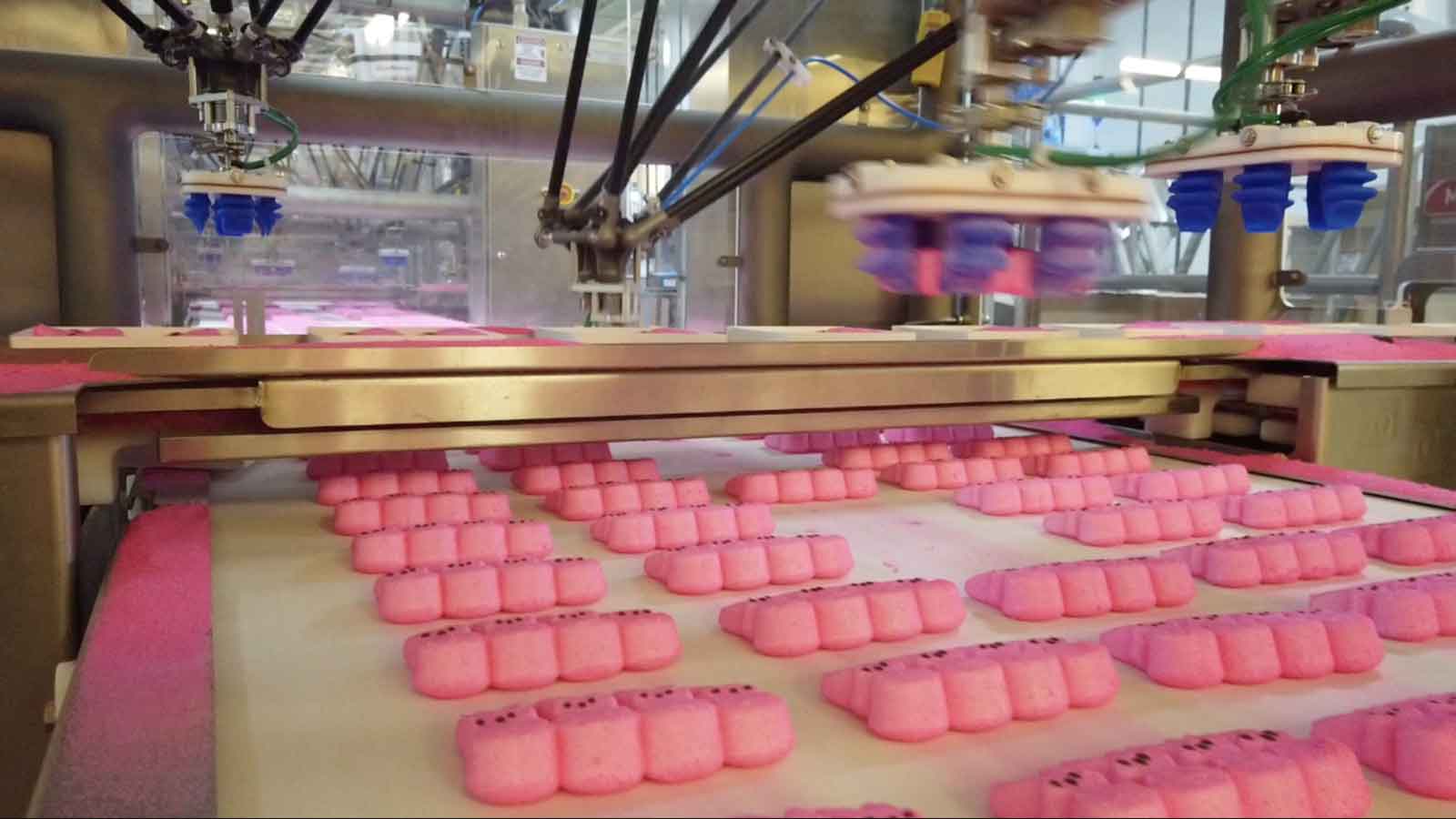 Primary Handling in the Food Zone: Why Your Pick-and-Place System Needs to Get Wet">
There's a fundamental difference between secondary packaging and primary handling that changes everything about how a robot needs to be built.
In secondary packaging, the robot handles sealed packages — trays, pouches, cartons, bags. The product is already protected inside its packaging. The robot touches the package, not the food.
In primary handling, the robot touches the food itself. Or it touches the food contact surface — the thermoformer pocket, the tray that hasn't been sealed yet, the conveyor where unpackaged product sits. At this stage, the robot operates in the food zone. And the food zone has rules that most industrial robots can't meet.
The Hygiene Standard Is Higher
USDA, FDA, and GFSI sanitation standards for the food zone — the area where unpackaged food is exposed — are significantly more demanding than standards for secondary packaging areas. Equipment that contacts or operates above unpackaged food must be cleanable to a microbial level. Every surface. Every joint. Every cable run.
In practice, this means the entire robot and its support structure need to withstand daily (or per-shift) high-pressure, high-temperature washdown with chemical sanitizers. Not just resist water ingress — actively get washed, inside and out, at pressures up to 1,450 psi and temperatures up to 180 degrees Fahrenheit.
Most industrial robots aren't built for this. Even IP67-rated robots — which can survive brief water immersion — aren't designed for repeated, aggressive chemical washdown. The seals degrade. Water gets in. Components corrode internally even when the exterior looks fine.
The Cover-Up Approach
The most common industry response to this gap has been to take standard industrial robots and add protective measures: stainless steel covers, bellows over joints, sealed enclosures around the base, boot-style guards over cabling. The robot underneath is still a standard industrial robot — the covers just keep water out.
This approach has three problems.
First, covers create cavities. The space between the cover and the robot body is a surface you can't see, can't reach, and can't verify is clean. Bacteria thrive in exactly these hidden, moist environments.
Second, covers complicate maintenance. Every maintenance event requires removing covers, performing the work, and reinstalling covers — correctly, with all seals intact. A cover reinstalled with a compromised seal after a midnight maintenance call is a sanitation risk that won't be visible until the next audit.
Third, covers don't change the underlying robot's material compatibility. Chemical sanitizers that are standard in food processing — peracetic acid, quaternary ammonium compounds, chlorinated alkaline cleaners — attack materials that weren't selected for chemical exposure. The covers keep the chemicals off the robot, but only as long as the covers remain intact.
Built for the Food Zone
The [Talon](https://www.jlsautomation.com/talon-packaging-systems) takes a fundamentally different approach. Instead of protecting a standard robot from the food zone, JLS built Talon for the food zone from the ground up.
IP69K washdown rating. Talon is rated for the most aggressive washdown protocols in food processing — high-pressure, high-temperature, chemical sanitation. Not survivable. Designed for it. The rating applies to the robot itself, not a cover over the robot.
Open-frame architecture. No covers. No enclosed cavities. No hidden surfaces. Every surface on the Talon is visible, accessible, and cleanable. Sanitation crews can see what they're cleaning and verify the result.
Sanitary materials throughout. Stainless steel construction. Round tube frames that eliminate flat surfaces where water pools. Bolted joints that can be disassembled for inspection. Cable routing designed with open channels — no pinch points where residue accumulates.
No retrofit. Talon isn't a standard industrial robot with hygienic modifications. It's a purpose-built food-zone robot. The material selection, joint design, surface geometry, and cable management were all specified for hygienic performance from the initial design.
Where Primary Handling Happens
Primary handling applications span the food industry:
- Protein: Loading unpackaged sausages, bacon drafts, chicken pieces, or deli meats into thermoformer pockets or trays before sealing
- Bakery: Placing baked goods into trays or packaging before wrapping
- Dairy: Handling cheese blocks, slices, or portions before packaging
- Produce: Sorting and placing unpackaged fresh items into consumer packaging
In every case, the robot operates in the food zone. In every case, the hygiene standard is non-negotiable.
The Decision
If your application involves handling unpackaged food or operating in the food zone, you have two choices: cover up a standard robot and manage the sanitation complexity that creates, or use a robot that was designed to operate in that environment without covers.
The Talon was built for the second approach.
[CTA: See the Talon Primary Handling System]
---
The Talon robotic packaging system is designed and built by JLS Automation in York, Pennsylvania. To learn more about primary handling automation, visit [jlsautomation.com/talon-packaging-systems](https://www.jlsautomation.com/talon-packaging-systems) or call (717) 505-3800.
What do you want to know?
By submitting, you agree that JLS Automation and Robert Reiser & Co. may contact you about your inquiry.
Reviewed by
JLS Automation Engineering — York, PA
See it run on your product
Bring us your product. We'll test it in our York, PA lab and prove the automation before you commit.
Schedule a facility tour