/JLS%C2%AE_MasterLogo_Navy.png)
 From Stuffer to Shipper: What a Fully Integrated Chub Line Looks Like">
Most chub producers don't have a packing problem. They have a line balance problem.
The upstream equipment — grinders, stuffers, clippers — runs at a pace the manual packing crew can't sustain. The stuffer doesn't slow down because your case packers need a break. So product backs up, throughput gets capped by the slowest human on the line, and the equipment you invested in upstream never reaches its rated capacity.
Automating the case packing step doesn't just eliminate manual labor at that station. It unlocks the throughput your line was designed to deliver.
Here's what that looks like from end to end.
Stage 1: Stuffing and Clipping
The line starts where it always does — your stuffer and clipper producing finished chubs. Whether you're running Handtmann, Vemag, Poly-clip, Tipper Tie, or another manufacturer's equipment, the output is the same: sealed chubs dropping onto a discharge conveyor at production speed.
The [Osprey CL](https://www.jlsautomation.com/automatic-chub-loading-system) integrates with all major chub-producing equipment. JLS application engineers handle the mechanical interface, controls communication, and timing synchronization between your existing stuffer/clipper and the automated case packing system.
Stage 2: V-TRACK Stabilization
This is where most automation attempts have historically failed. Chubs land on the conveyor and roll — making reliable robotic picking nearly impossible on conventional flat-belt systems.
The Osprey CL's proprietary [V-TRACK™ pick conveyor](https://www.jlsautomation.com/automatic-chub-loading-system) solves this with a V-shaped profile that cradles each chub in a stable, repeatable position. The chub settles into the V naturally. No lane guides. No timing screws. No mechanical fixtures that add complexity and cleaning burden.
With product stabilized on V-TRACK, the vision system accurately identifies each chub's position and orientation — setting up a clean pick every time.
Stage 3: Robotic Pick and Place
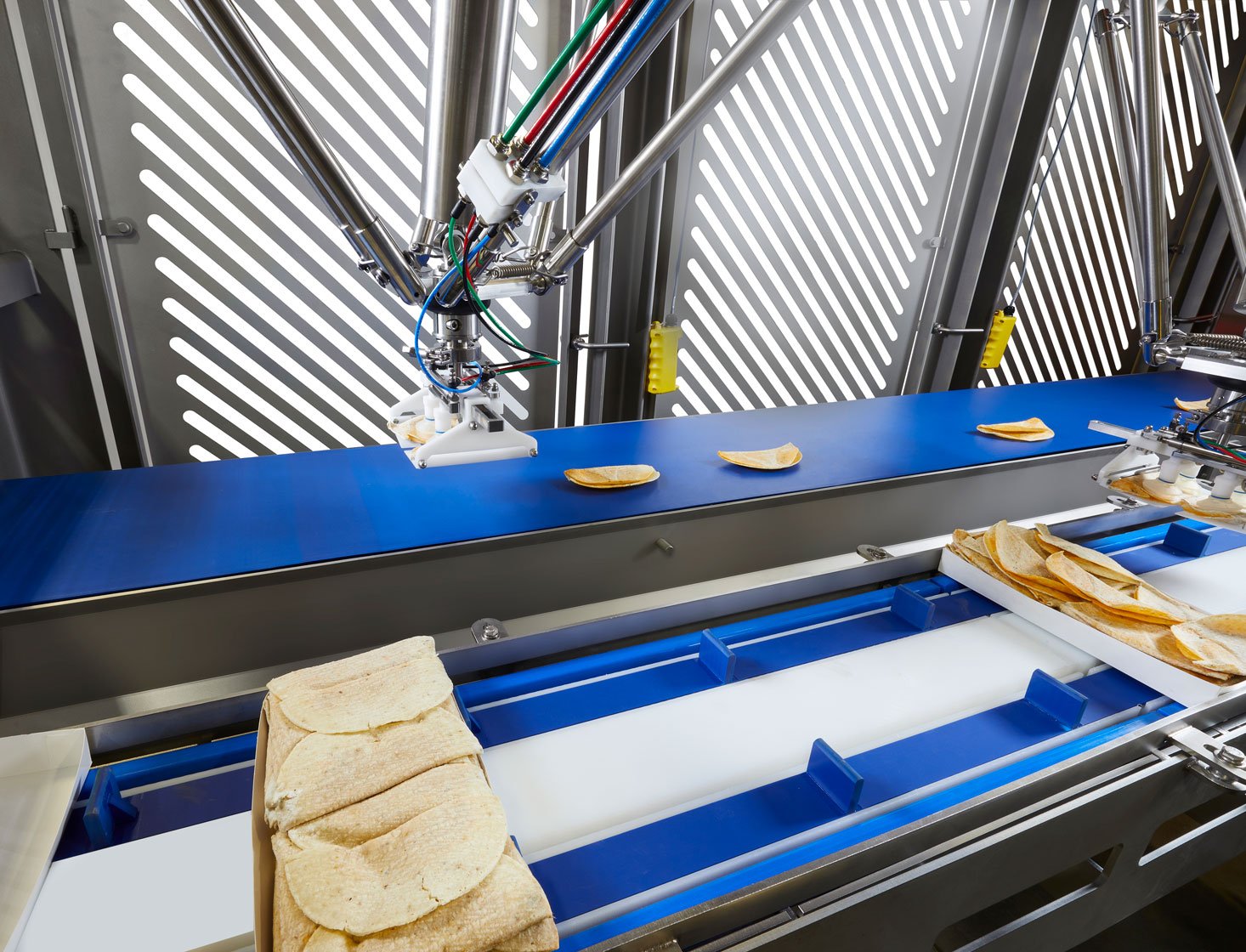
Vision-guided delta robots with JLS's proprietary VOB® (Vacuum On Board) tooling acquire chubs from the V-TRACK conveyor and place them into precise case-pack patterns.
The system handles chubs from 2" to 4.5" diameter, 4" to 24" long, and 8 oz to 10 lbs — covering ground beef, sausage, pet food, cookie dough, and specialty food logs. A single robot head runs at up to 125 chubs per minute. A dual-head configuration reaches 200 chubs per minute.
The VOB® tooling is configured to your exact chub format. When you change products, the EOAT (end-of-arm tool) swaps without tools — it's part of a total changeover process that takes less than one minute.
Stage 4: Case Management
The Osprey CL's flight-free conveyor provides continuous-motion case transport — no constant start/stop cycling that creates mechanical wear and timing complications. Pinch belts maintain superior case control throughout the loading sequence.
Cases are erected, loaded, and sealed in a decoupled process. The system handles RSC, HSC, retail-ready, club-store, and custom case formats — all from the same platform. Switching between case configurations is managed through the HMI alongside the product changeover recipe.
Stage 5: Palletizing and Distribution
Loaded and sealed cases discharge to your palletizer and distribution system. Because JLS builds on the B&R Automation controls platform — the same platform used across the Talon, Osprey, Hawk, and Peregrine product families — the Osprey CL communicates seamlessly with downstream equipment. No separate controls interface. No integration headaches.
The Line Balance Payoff
When the case packing step runs at the same speed as your stuffer, the entire line operates in balance. You're not throttling upstream equipment to match manual packing speed. You're not rotating packing crews through shifts to sustain throughput. And you're not leaving grinder and stuffer capacity on the table.
For a ground meat producer running a dual-head Osprey CL at 200 chubs per minute, the math is straightforward: that throughput matches or exceeds the output of most commercial stuffing lines. The bottleneck moves from packing to wherever you want it — and it's no longer your people.
One Integration Scope
JLS handles the full integration — from mechanical interfaces with your stuffer/clipper to controls communication with your palletizer. Concept design, system engineering, factory acceptance testing at JLS's facility in York, Pennsylvania, and installation support at your plant.
If you're evaluating how to bring your chub line into balance, it starts with a conversation about your specific products, speeds, and facility layout.
[CTA: Talk to a JLS Application Engineer]
---
JLS Automation designs and builds integrated robotic packaging systems in York, Pennsylvania. To discuss your chub packaging line, visit [jlsautomation.com/automatic-chub-loading-system](https://www.jlsautomation.com/automatic-chub-loading-system) or call (717) 505-3800.
What do you want to know?
By submitting, you agree that JLS Automation and Robert Reiser & Co. may contact you about your inquiry.
Reviewed by
JLS Automation Engineering — York, PA
See it run on your product
Bring us your product. We'll test it in our York, PA lab and prove the automation before you commit.
Schedule a facility tour