/JLS%C2%AE_MasterLogo_Navy.png)
 Flat Pack vs. Vertical Pack: How to Choose the Right Case Configuration for Pouches">
When you're case packing pouches — pillow bags, stand-up pouches, vacuum packs, or thermoformed flexible packs — one of the first decisions you'll make is whether to load them flat or standing up.
It's not just a packing preference. The choice affects case density, retail shelf presentation, product protection during shipping, and how complex your automation needs to be. Here's how to think through it.
Flat Pack: The Default for Most Applications
Flat packing means laying pouches horizontally in the case, typically stacked in layers. It's the most common approach for foodservice and club-store distribution, where the product goes from the case directly to a prep area or storage — not onto a retail shelf.
Flat pack works well when:
- Products ship in bulk to foodservice, institutional, or warehouse channels
- Case density matters more than retail presentation
- Pouches are flexible and conform to stacking without damage
- You're running high-speed lines where simplicity equals uptime
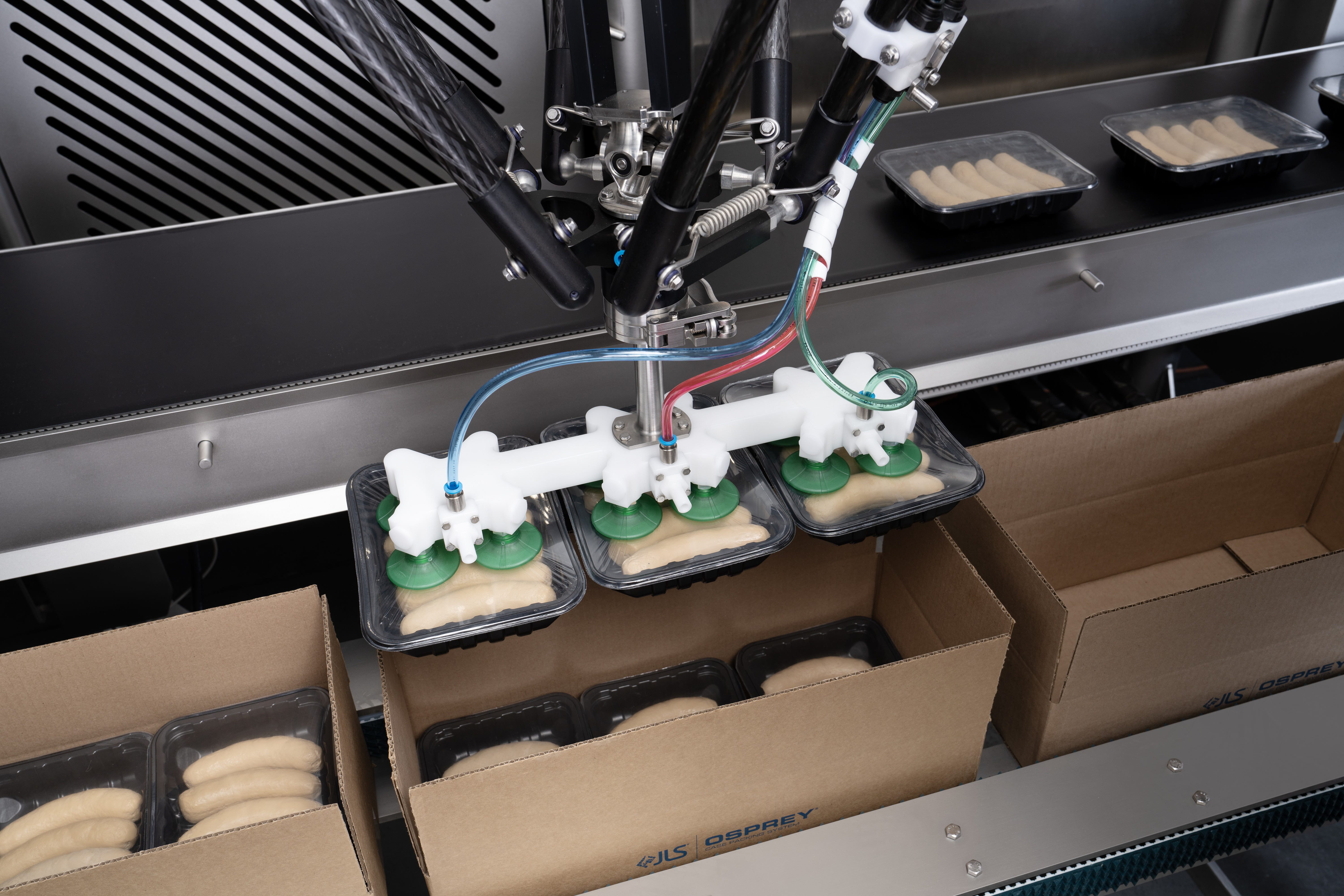
From an automation standpoint, flat packing is the simpler operation. The robot acquires the pouch from the infeed conveyor and places it directly into the case. No reorientation required. The [Osprey BP](https://www.jlsautomation.com/osprey) handles flat packing at full speed with its vision-guided delta robots and VOB 2.0® vacuum tooling — the robot sees the pouch, picks it, and places it in the configured pattern.
Vertical Pack: When Retail Presentation Matters
Vertical packing — loading pouches standing upright in the case — is increasingly common for retail-ready and club-store applications. When the case lid comes off on the store shelf, consumers see product labels facing forward. It's a merchandising advantage that retailers are demanding from more categories.
Vertical pack works well when:
- Cases go directly to retail shelves (retail-ready packaging)
- Brand visibility and label presentation drive sales
- Stand-up pouches (SUPs) need to be displayed upright
- Club-store or warehouse club formats require vertical orientation
Vertical packing is more mechanically complex. The robot needs to pick a flat pouch off the conveyor, reorient it to vertical, and load it standing up — all at production speed without damaging the package or disrupting the seal.
The Osprey BP handles this with a quick-install cartridge system. An articulating gripper EOAT picks the flat pouch, orientates it vertically, and loads it into a loading cartridge that discharges pouches upright into the case. The cartridge change adds only seconds to the total changeover process — no vision system changes required between flat and vertical SKUs.
The Changeover Question
For producers running both flat and vertical SKUs on the same line, changeover time is the critical factor. If it takes 30+ minutes to reconfigure your case packer for a different pack orientation, you're losing real production time every time you switch.
On the Osprey BP, changing from flat pack to vertical pack requires:
- Select the new recipe on the HMI
- Swap the loading cartridge (quick-install, no tools)
- Adjust the case guide rails
Total changeover: under 10 minutes, including the cartridge swap. No mechanical rebuilds. No reprogramming the vision system. No calling in a technician.
This matters most for producers with mixed product portfolios — running ground turkey pouches for foodservice in the morning and branded stand-up pouches for retail in the afternoon. The faster you switch, the more productive SKUs you can run on a single line.
What About Shingled Arrangements?
There's a third option that falls between flat and vertical: shingled packing, where pouches overlap at an angle inside the case. This is sometimes used for thermoformed packs or heavier pouches where flat stacking creates too much weight on the bottom layer.
The Osprey BP supports shingled arrangements through case fill pattern configuration on the HMI. The vision-guided robots place each pouch at the programmed angle and overlap — no mechanical fixtures or custom lane guides required.
Choosing the Right Configuration
The decision usually comes down to your channel:
| Factor | Flat Pack | Vertical Pack | |--------|-----------|---------------| | Best for | Foodservice, institutional, bulk distribution | Retail-ready, club store, branded shelf display | | Case density | Higher (more product per case) | Lower (vertical orientation takes more space) | | Retail presentation | Not a factor | Critical — labels face forward | | Automation complexity | Simpler pick-and-place | Requires reorientation step | | Changeover | Recipe change + EOAT swap | Recipe change + EOAT swap + cartridge swap |
If you're running a single channel, the choice is straightforward. If you're running mixed channels on the same line, you need a case packer that handles both without major downtime between switches.
The Osprey BP was designed for exactly that flexibility. One platform. Both orientations. Changeover measured in minutes, not hours.
[CTA: See How the Osprey BP Handles Your Product]
---
JLS Automation designs and builds hygienic robotic case packing systems in York, Pennsylvania. To discuss your pouch packing application, visit [jlsautomation.com/osprey](https://www.jlsautomation.com/osprey) or call (717) 505-3800.
What do you want to know?
By submitting, you agree that JLS Automation and Robert Reiser & Co. may contact you about your inquiry.
Reviewed by
JLS Automation Engineering — York, PA
See it run on your product
Bring us your product. We'll test it in our York, PA lab and prove the automation before you commit.
Schedule a facility tour