/JLS%C2%AE_MasterLogo_Navy.png)
 Custom End-of-Arm Tooling: How JLS Designs a Gripper for Your Exact Product">
A robot is only as capable as its end-of-arm tool. The EOAT — the gripper, the vacuum tool, the mechanism that actually contacts the product — is what determines whether the system picks reliably, places accurately, and runs without dropping product or damaging packages.
In food packaging, this is where one-size-fits-all breaks down completely.
Why Universal Grippers Don't Work in Food
Industrial automation catalogs are full of universal grippers — adjustable vacuum cups, adaptable mechanical fingers, multi-purpose tooling designed to handle a range of product geometries. In warehouse and logistics applications, where products come in standardized boxes and packages, these tools work well enough.
Food is different. A 1-lb sausage chub has a different surface texture, weight, flexibility, and shape than a bacon draft. A blueberry clamshell handles nothing like a block of cheddar cheese. A stand-up pouch of shredded chicken requires fundamentally different vacuum characteristics than a thermoformed MAP tray of sliced turkey.
The surface of the product, its weight distribution, its rigidity (or lack thereof), its temperature, its packaging material, whether it's slippery with moisture or sticky with fat — all of these determine what the EOAT needs to do. A universal suction cup set to a standard vacuum pressure will either grip too hard (deforming the product or damaging the package) or too loosely (dropping the product mid-cycle).
Neither outcome is acceptable at production speed.
The JLS EOAT Design Process
Every JLS packaging system ships with end-of-arm tooling designed specifically for the customer's exact product. Here's how that process works.
Step 1: Product Samples
The process starts with real product. JLS application engineers request samples of every SKU the system will handle — not just the primary product, but all the formats that will run on the line. Weight variations, packaging materials, seasonal differences, and any known product variability are documented.
This isn't optional. You can't design a gripper from a spec sheet. The EOAT design needs to account for how the product actually behaves — how it deforms under vacuum, how its surface responds to different cup materials, how its weight shifts when lifted at speed.
Step 2: Application Engineering
JLS application engineers design the EOAT based on the product samples. This includes:
- Vacuum cup layout: The number, size, and position of vacuum cups on the tool face, optimized for the product's surface area and weight distribution
- Suction force calibration: Vacuum force matched to the product's weight and surface characteristics — enough to hold securely through the pick-transport-place cycle, not so much that the product deforms or the package is damaged
- Gripper geometry: The physical shape of the tool body, designed to access the product in its orientation on the infeed conveyor and release it cleanly in the case or tray
- Material selection: Cup material and tool surface materials selected for chemical compatibility with food-contact sanitizers and the specific product being handled (some products are oily, some are frozen, some are moist)
Step 3: Validation on Real Product
The EOAT design is validated on actual product before the system ships. During factory acceptance testing at JLS's facility in York, Pennsylvania, the tooling runs against real product at production speed. Pick success rate, placement accuracy, and product condition are measured and verified.
If the tooling doesn't perform to specification on real product, it gets redesigned and retested — before the system leaves York.
Step 4: Tool-Less Changeover in Production
For operations running multiple SKUs, the EOAT swap is designed for tool-less changeover. The operator unclips the current tool and clips on the tool for the next product — no wrenches, no bolts, no vacuum line reconnections. Combined with HMI recipe selection, the full product changeover (EOAT swap, case or tray format change, vision system recipe) takes minutes.
Each SKU gets its own EOAT, optimized for that specific product. The changeover is fast because the tools are designed for quick-change from the start — not because the tooling is a compromise that tries to handle multiple products with one configuration.
The Range of Applications
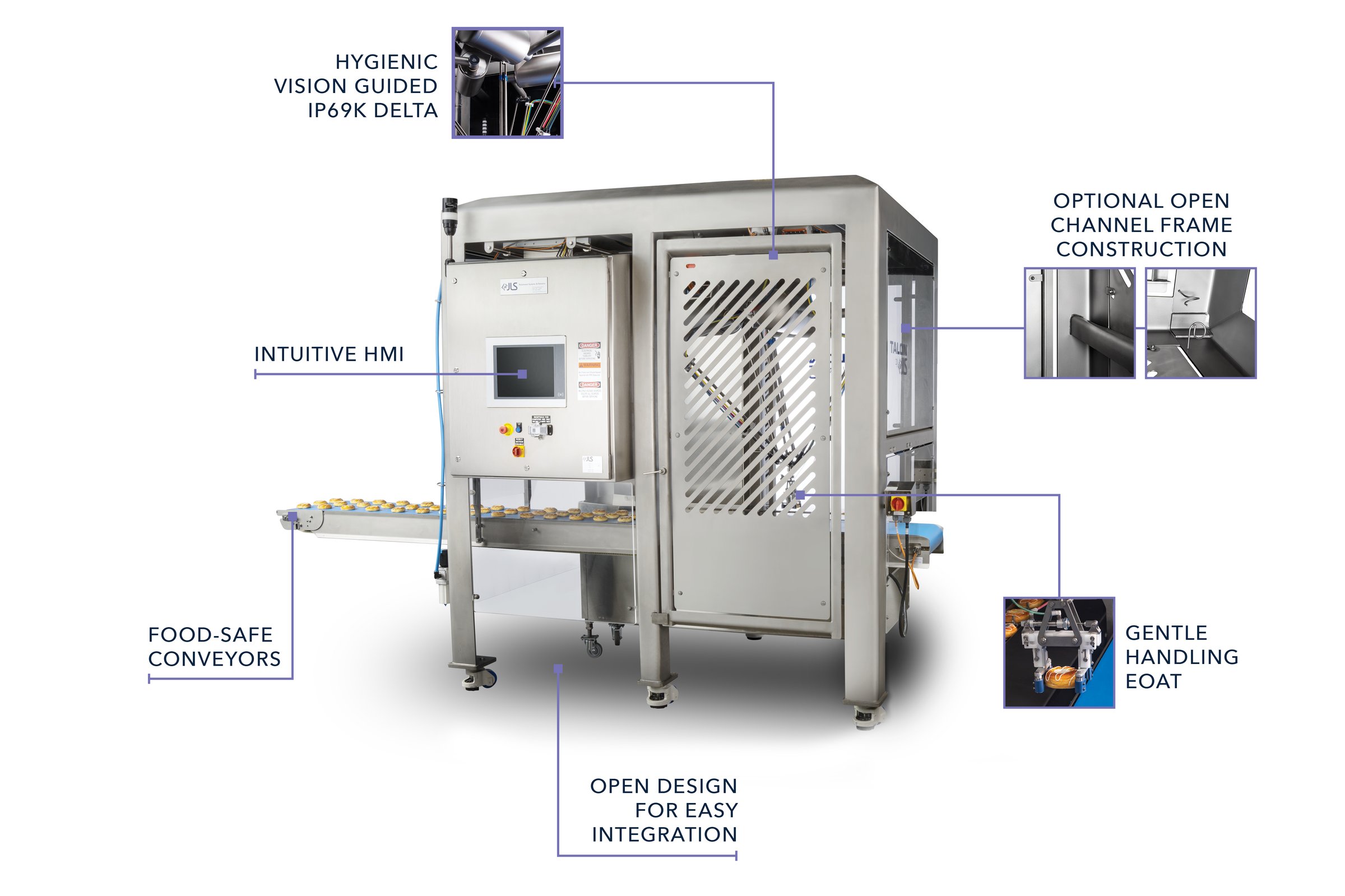
JLS designs custom EOAT for applications across the [Talon](https://www.jlsautomation.com/talon-packaging-systems) primary handling platform and the Osprey case packing family:
- Sausage and chub: VOB vacuum tooling on Osprey CL, shaped for cylindrical product
- Bacon drafts: Articulating gripper on Harrier, designed for fold-and-load operations
- Pouches and bags: VOB 2.0 on Osprey BP, calibrated for flexible package surfaces
- Trays: Vacuum tooling on Osprey TL, configured for MAP, VSP, and lidded tray geometries
- Cheese, deli, bakery: Custom primary handling tools on Talon, food-contact safe
Every product is different. Every EOAT is different. That's the point.
[CTA: Send Product Samples and Start the EOAT Design Process]
---
JLS Automation designs and builds custom end-of-arm tooling for hygienic robotic packaging systems at its facility in York, Pennsylvania. To discuss your product handling requirements, visit [jlsautomation.com/talon-packaging-systems](https://www.jlsautomation.com/talon-packaging-systems) or call (717) 505-3800.
What do you want to know?
By submitting, you agree that JLS Automation and Robert Reiser & Co. may contact you about your inquiry.
Reviewed by
JLS Automation Engineering — York, PA
See it run on your product
Bring us your product. We'll test it in our York, PA lab and prove the automation before you commit.
Schedule a facility tour