/JLS%C2%AE_MasterLogo_Navy.png)
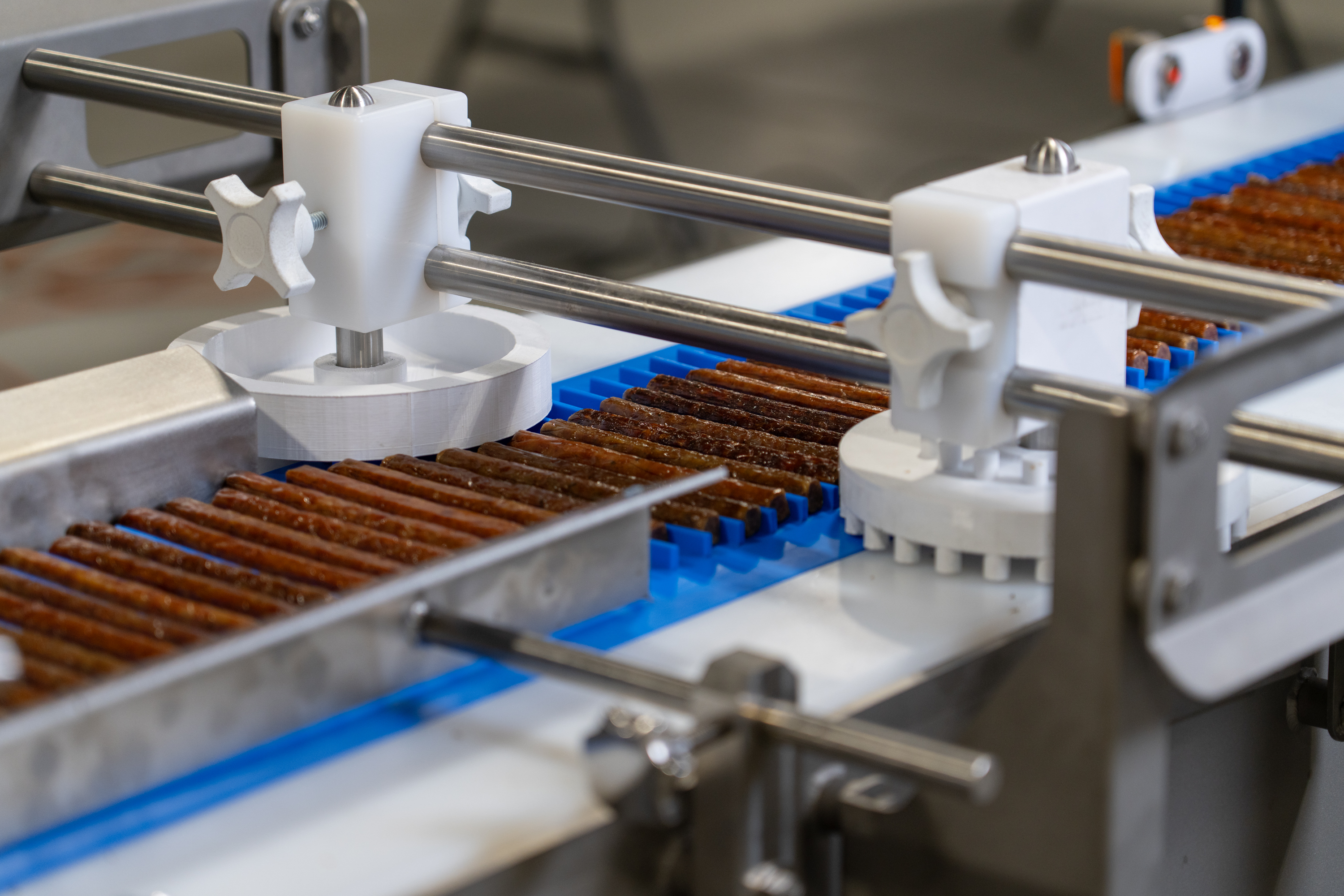 Collate and Load: How Robotic Collation Eliminates a Manual Bottleneck">
Before a product goes into a case, it usually needs to be arranged into a group. Four pouches in a row. Six cartons in a 2x3 pattern. Eight trays in two layers of four. That arrangement — the collation step — determines how the product sits in the case and how efficiently the case fills the pallet.
In many packaging operations, collation is where automation stops and manual labor starts.
The case packer loads product into cases. The palletizer stacks cases onto pallets. But the step between the infeed conveyor and the case packer — grouping individual products into the correct pattern — is often done by workers standing at the line, arranging products by hand.
It's a bottleneck that limits throughput, depends on labor availability, and introduces variability that cascades downstream.
Why Collation Stays Manual
Collation seems like it should be easy to automate. Products arrive on a conveyor. They need to be grouped into a pattern. A robot picks and places them.
The challenge is variety. Different products, different case configurations, and different customer requirements all demand different collation patterns. A retail club-store case might need a 3x4 array with labels facing up. A foodservice case might need shingled stacking. A mixed-variety pack might combine multiple SKUs in a single case.
When the collation pattern changes, a mechanical collation system — lane guides, diverters, timing screws — needs to be physically reconfigured. That reconfiguration takes time, requires trained technicians, and limits how many different patterns you can practically run on a single line.
The result: many operations default to manual collation because it's flexible. Workers can change patterns instantly. They can handle product variation. They can accommodate last-minute changes.
The tradeoff is that manual collation can't keep up with automated case packing. The case packer waits for the collation station. The line runs at manual speed.
What the Kestrel Changes
The [Kestrel](https://www.jlsautomation.com/kestrel) automates both collation and loading in a single system. Vision-guided robots see individual products on the infeed conveyor, pick them, arrange them into the programmed collation pattern, and load them into cases — all in one continuous operation.
No separate collation station. No manual arrangement step. No mechanical lane guides that need to be reconfigured for each pattern.
The collation pattern is defined in the HMI recipe. When you switch from a 2x3 pattern to a 3x4 pattern — or from flat collation to shingled — you change the recipe. The vision system and robot motion adapt automatically. No hardware changes. No technician required.
This flexibility is what makes the Kestrel fundamentally different from mechanical collation systems. Mechanical systems are rigid — they're efficient at one pattern and require downtime to change to another. The Kestrel is programmable — it handles multiple patterns on the same hardware with recipe-driven changeover.
The Labor Math
Count the people at your collation station. In a typical operation running two shifts, you might have two to four workers per shift arranging products for case loading. That's four to eight positions across the day.
Multiply by your fully loaded labor cost — hourly rate, benefits, overtime, turnover costs, training — and you have the annual cost of manual collation. For most operations, that number is significant enough to justify the Kestrel conversation on labor savings alone.
But the throughput gain often matters more than the labor savings. Manual collation caps your line speed at the pace of the workers. Automated collation runs at the pace of the robot — consistently, across all shifts, without fatigue-related slowdown.
Multiple Product Types
The Kestrel handles the full range of product formats that require collation before case loading:
- Pouches and bags: Flat or vertical collation for flexible packages
- Cartons and clamshells: Rigid container grouping in variable patterns
- Trays: Sealed tray arrangement for multi-pack cases
- Mixed packs: Multiple SKUs collated into variety-pack configurations
The vision system identifies each product individually, regardless of how it arrives on the infeed conveyor. Products don't need to be pre-oriented or pre-spaced. The robot handles the sorting, orienting, and arranging — the tasks that workers currently do by hand.
Where Kestrel Fits in the Line
The Kestrel sits between your upstream packaging equipment and your case sealer/palletizer. It replaces both the manual collation station and the separate case loading step with a single automated system.
For operations already running a JLS case packer (Osprey or Hawk) that don't have automated collation, the Kestrel can be integrated upstream on the same B&R controls platform. One network. One HMI. One recipe-based changeover for the entire collation-and-packing sequence.
If your case packer is waiting on your collation station, the bottleneck has a solution.
[CTA: See How the Kestrel Handles Your Collation Pattern]
---
The Kestrel robotic collation and loading system is designed and built by JLS Automation in York, Pennsylvania. To discuss your collation application, visit [jlsautomation.com/kestrel](https://www.jlsautomation.com/kestrel) or call (717) 505-3800.
What do you want to know?
By submitting, you agree that JLS Automation and Robert Reiser & Co. may contact you about your inquiry.
Reviewed by
JLS Automation Engineering — York, PA
See it run on your product
Bring us your product. We'll test it in our York, PA lab and prove the automation before you commit.
Schedule a facility tour