/JLS%C2%AE_MasterLogo_Navy.png)
 Automating MAP Tray Case Packing Without Compromising Seal Integrity">
Modified atmosphere packaging keeps product fresh. A compromised seal turns it into a liability.
MAP trays — the sealed trays of sliced deli meat, fresh chicken, ground beef, and ready-to-eat meals you see in every grocery cooler — rely on a precise gas mixture inside the package to extend shelf life. Nitrogen, carbon dioxide, and residual oxygen in carefully controlled ratios inhibit bacterial growth and maintain product quality. But that gas mixture only works if the seal holds.
Break the seal and you lose the atmosphere. Lose the atmosphere and shelf life collapses. Product gets pulled. Retailers lose confidence. Your brand takes the hit.
This is why automating MAP tray case packing isn't just a throughput question. It's a seal integrity question.
Where Seals Get Compromised
Most seal failures in MAP trays don't happen at the tray sealer. They happen downstream — during handling, case packing, and transport. The seal is the most vulnerable part of the package, and it sits right at the edge where handling equipment makes contact.
Manual case packing creates inconsistent handling. Workers grab trays at different angles, apply different grip pressures, and place them into cases with varying degrees of care. As production speed increases and fatigue sets in, seal damage climbs. A packer in hour seven of a shift isn't handling trays with the same precision as in hour one.
Conventional automation introduces its own risks. Mechanical grippers that clamp the tray body can distort the flange. Pusher-style loaders that slide trays across surfaces create friction on the seal edge. Any system that doesn't account for the fragility of the seal zone is trading one problem for another.
How the Osprey TL Protects the Seal
The [Osprey TL](https://www.jlsautomation.com/osprey-case-packing-systems/tray-loading-0) was designed specifically for sealed tray formats — MAP, sleeved, vacuum skin pack (VSP), and lidded trays. The system uses IP65-rated high-payload delta robots (with optional IP69K upgrade for full washdown environments) and vision-guided placement to handle each tray without contacting the seal zone.
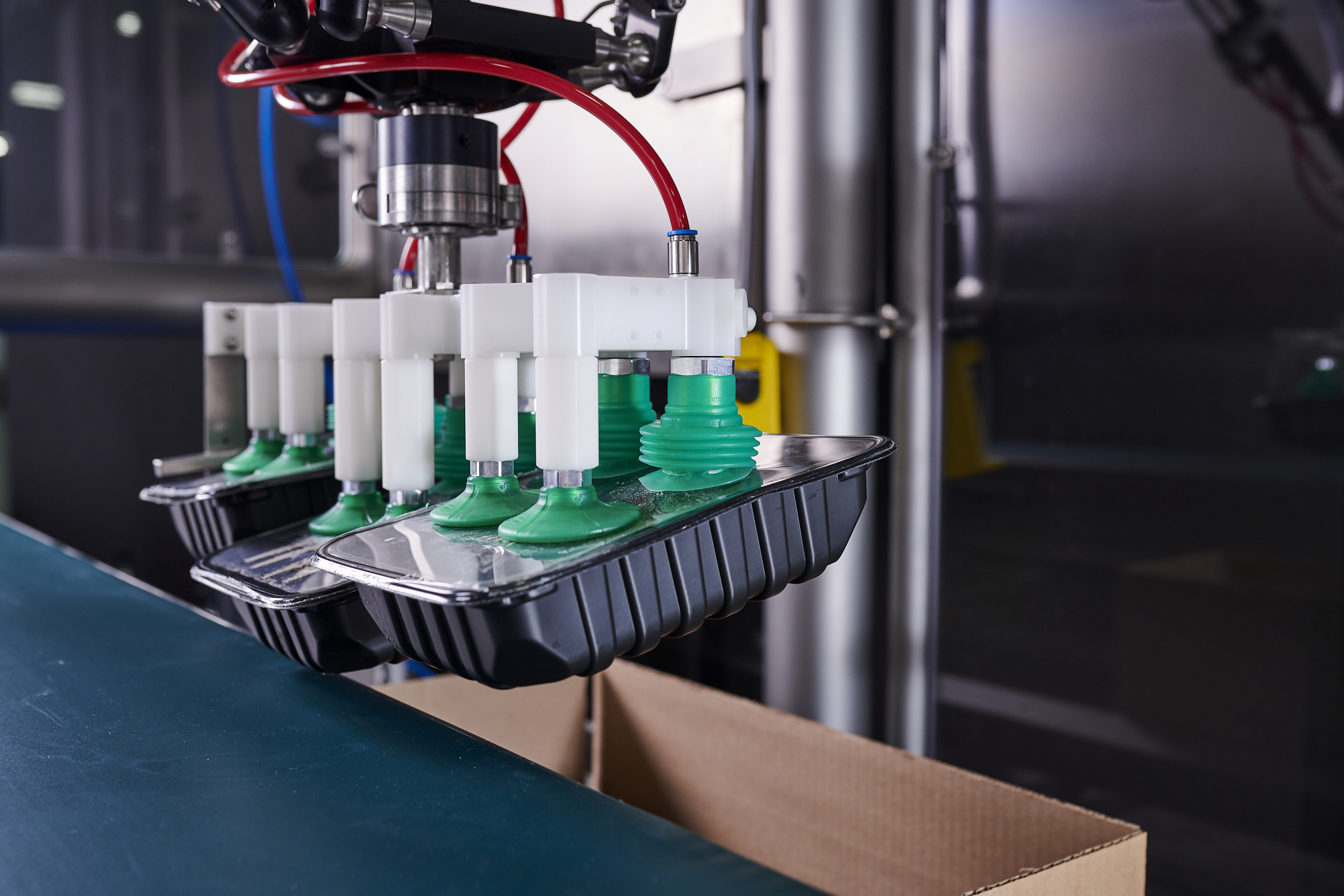
The robot acquires the tray from above using vacuum tooling matched to the tray's geometry. The vacuum cups contact the tray lid surface — not the flange, not the seal edge. The vision system identifies each tray's exact position and orientation on the infeed conveyor, so the robot doesn't have to search or reposition. One clean pick. One precise placement into the case pattern.
This matters because every unnecessary contact point is a potential seal failure. The fewer times you touch the seal zone, the lower your reject rate.
Inline Leak Detection with PIVT
Even with careful handling, some compromised packages will make it through any production line. The question is whether you catch them before they ship.
The Osprey TL integrates with JLS's PIVT (Pressure Inspection and Vacuum Testing) leak detection system, which checks seal integrity inline — at production speed, on every package. Trays with compromised seals are identified and rejected before they reach the case. No sampling. No manual inspection. No reliance on finding the problem at the distribution center or, worse, on the retail shelf.
For operations running MAP trays, inline leak detection isn't a luxury. It's the difference between catching a seal failure at your plant and catching it as a customer complaint.
Speed Without Compromise
The Osprey TL handles MAP trays at production speeds that match upstream tray sealers. The delta robots provide the payload capacity to handle heavy tray formats — including the dual-compartment and family-size trays that are increasingly common in retail — while maintaining the placement precision that protects seal integrity.
Changeover between tray formats is managed through the HMI recipe system. Switch from a single-serve sliced turkey tray to a family-pack ground beef tray without mechanical rebuilds. The vision system, vacuum tooling, and case patterns all adjust to the new product recipe.
The Real Calculation
If you're running MAP trays and still packing by hand, count your seal-related rejects for a week. Then count them again after tracking which stage of your line generates the most damage. In most operations, case packing is the leading source of post-seal failures — not because workers are careless, but because manual handling at speed is inherently inconsistent.
Automating that station with equipment designed for sealed trays doesn't just reduce labor. It protects the seal integrity that your entire MAP process depends on.
[CTA: See the Osprey TL Tray Loading System]
---
JLS Automation designs and builds hygienic robotic packaging systems at its facility in York, Pennsylvania. To learn more about automating MAP tray case packing, visit [jlsautomation.com/osprey-case-packing-systems/tray-loading-0](https://www.jlsautomation.com/osprey-case-packing-systems/tray-loading-0) or call (717) 505-3800.
What do you want to know?
By submitting, you agree that JLS Automation and Robert Reiser & Co. may contact you about your inquiry.
Reviewed by
JLS Automation Engineering — York, PA
See it run on your product
Bring us your product. We'll test it in our York, PA lab and prove the automation before you commit.
Schedule a facility tour